EN
From 28 August, Galerie Monica Ruppert presents works by the Berlin-based artist Peter Böhnisch as part of the Art Experience. The exhibition focuses on his most recent paintings and offers insight into a painterly practice that brings together materiality and space, narrative openness and formal precision in a conceptual manner. Notable here is the interplay of aesthetic elegance, formal systematics and a finely calibrated balance between seriousness and subtle irony. In this respect, the works are exceptional.
One pictorial characteristic is a technique of his own devising, in which he repeatedly breaks open the surface using sand, pigments and minerals such as corundum, thereby reinterpreting the boundaries between painting and relief. He works on a range of supports, including wood, MDF, canvas and paper. The material does not serve merely as a carrier but becomes a constitutive agent of the image, its mineral, relief-like structures lending what is depicted a sculptural dimension. To this Böhnisch adds a palette of earthy browns, ochres and oranges, muted greens and yellows, velvety blue and turquoise, or a shimmering red and copper red, producing the overall impression of an idiosyncratic, contemplative atmosphere. Nothing imposes itself, not even where individual accents of colour are given a stronger presence.
Against this artistic idiom, landscapes, objects and figures unfold, which Böhnisch combines with symbolic elements, narrative fragments or subtle allusions. Archaic intimations meet contemporary pictorial signs and condense into a balanced visual language that joins mysticism and everyday life, conveying pictorial space as existential and present, then again as dreamlike, ornamental or still. The figures appear as travellers between different realities and strata of time, their origins left undetermined.
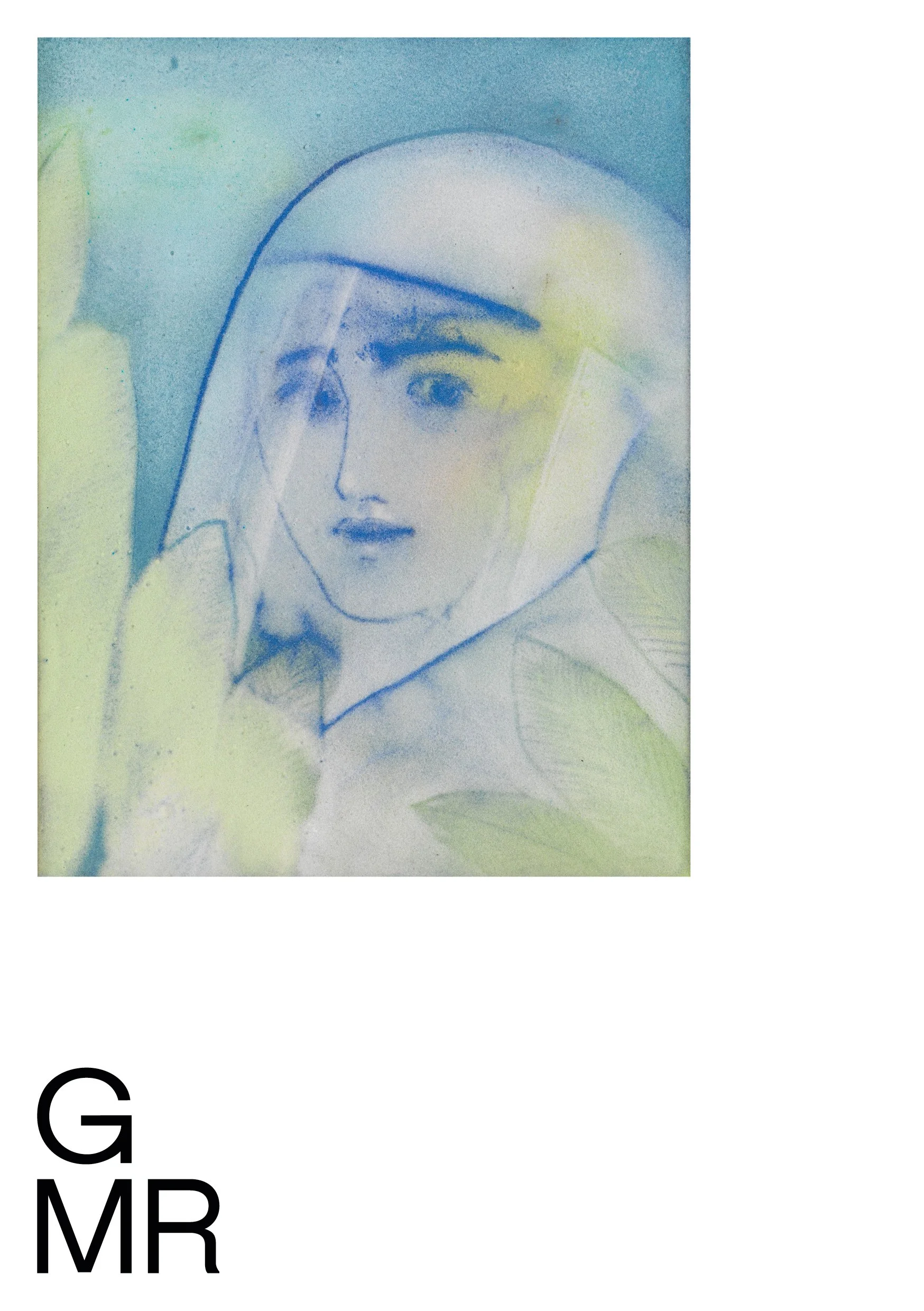
This visual language emerges strikingly in the astronaut-like figures, as in the painting First Contact. A woman is shown, framed by delicate leaves, meeting the viewer with a gaze at once slightly startled and remote. Behind the visor of her astronaut's helmet, which models her face like a fine veil, she seems to move between presence and withdrawal. The helmet is far more than a reference to future technologies. It functions as a threshold motif, mediating between inside and outside, closeness and distance, protection and vulnerability. While the title First Contact points to the moment of a first encounter, it remains uncertain who is actually encountering whom: is it the human being approaching the unknown, or is it the picture itself that draws the viewer under its enigmatic spell?
This openness also determines the mystical dimension of Böhnisch's pictorial worlds. The mystical moment arises not through the depiction of the supernatural, but through a visual language that opens up transitions. Recurring symbols such as oval rings of light recalling haloes, or a lemniscate, can be understood as signs of such threshold states. The halo, however, refers less to religious iconography than to moments of inner concentration or intuitive insight; the lemniscate, in turn, stands for continuity, cyclical time and the joining of apparent opposites. Together with the astronaut's helmet, these motifs form a symbolic grammar of transition. They speak of transformation and of the human search for that hidden connection which binds the visible and the invisible, reality and imagination. Böhnisch's landscapes and figures likewise point to such pictorial spaces, which do not fix meaning but allow it to form anew in the act of seeing.
In this way, every encounter with his works becomes a first contact: an approach to a pictorial world whose mysteries are never exhausted. The sensuous experience of materiality and the conceptual openness of the images are inseparably bound together. In this sense, Böhnisch's pictorial worlds can be related to Gaston Bachelard's understanding of poetic space: spaces are not only sites of external reality, but repositories of imaginings and inner images.
After studying at the State Academy of Fine Arts in Karlsruhe with Anselm Reyle and Andreas Slominski, Peter Böhnisch initially devoted himself to large-format drawings. Over the course of his artistic development, he continually expanded his repertoire to include ink, wax crayon, beeswax, acrylic and pastel on canvas. Through his engagement with these materials, he developed the pictorial compositions that characterise his sand paintings today and that reveal the complexity of modernism within contemporary painting.
Peter Böhnisch's work has been exhibited in numerous galleries and museums.
Text: Dr. Christine Karallus